Short answer: a demand planner builds the most accurate unbiased view of future demand the business can produce, then gets sales, marketing, supply chain, operations, finance and management to improve it and commit to one number. The best planners do more than predict. They tell leadership what to do about the forecast. Forecasting becomes a team sport when every function adds what it knows, at the right level, in the right order, and each input is measured against the statistical baseline.
What does a demand planner actually do?
Demand planning is the one function that works directly on the company’s objective of selling, and it is usually the first to spot when demand is moving away from the plan. Yet in many companies it still sits as a sub-function under supply chain, sales or finance, and rarely gets a seat at the top table.
History offers a clue as to why. In ancient courts the forecaster sat next to the king. The Bible tells how Joseph forecast seven years of plenty followed by seven years of famine for Pharaoh, perhaps the first recorded long-range forecast. What earned him his place was not the prediction alone. It was the advice that came with it: store grain in the good years and sell it in the lean ones. Egypt came through the famine. Had he simply predicted the famine and trimmed inventory to match, he would have been a good forecaster, but never put in charge of Egypt.
That is the distinction every planner needs to understand:
- Forecasting is the prediction of demand: an honest, unbiased estimate of what customers will buy.
- Planning is the proposal for changing that prediction: how to shape demand favourably, close a gap or avoid a loss.
The two are sequential, and a good professional does both. The day-to-day work of the role includes:
- Cleaning sales history, correcting outliers and marking events such as promotions, stockouts and one-off orders.
- Building a robust statistical baseline for every product and location.
- Adding known business information as overrides, with a reason for each one.
- Running the demand review and bringing each function’s input into one consensus forecast.
- Tracking accuracy and bias, and explaining why the forecast missed.
- Presenting the risks and opportunities to leadership, along with options for acting on them.
Where does the planner add value?
When demand planning is hosted inside supply chain, it tends to inherit supply chain thinking. If the forecast shows a decline, the instinctive response is to cut production and freight to match. That is the right reaction for supply chain, whose job is to meet demand at the lowest cost. It is not how a chief executive thinks. A CEO facing a forecast decline wants to know how to recover the volume, and the planner should already have the options in the forecast presentation: a promotion, a channel push, a price move or a product substitution.
The planner’s value shows up in three places.
Better service and less stock at the same time
Safety stock exists to cover two kinds of uncertainty: variation in supplier lead time and error in the demand forecast. Most companies move up and down a fixed trade-off curve, adding inventory to lift customer service or cutting service to free cash. Reducing forecast error shifts the whole curve. The company can hold the same stock and serve customers better, or hold service steady and release working capital. It needs no new capital, only knowledge the organisation already has.
An early warning for the business
The planner sees demand moving first, so they can flag a gap to the annual plan while there is still time to act.
Proposals, not just numbers
Every forecast that points to a shortfall should come with a recommendation. That is what turns the planner from a number-cruncher into an adviser to management.
Collaboration and S&OP: selling your forecast
Ask any group of planners what makes sales and operations planning succeed and the first answer is always management support. That matters, but planners cannot control it beyond a point. They can control how well they sell their forecast inside the business. Round-table conversations among practitioners keep returning to the same practical tactics:
- Show sales what is in it for them. Once the sales team sees the planning team as the people who help them hit their targets, the dynamic flips. Planners stop chasing sales for review meetings, and sales start chasing planners. It takes several cycles, but it lasts.
- Put accuracy in money terms. A planner with a finance background presented forecast error as notional financial gain or loss. Sales challenged the numbers, which was the point: it brought them into the room and forced the discussion.
- Frame risks positively. Describing a risk in terms of what can be protected or won holds an audience better than a list of what might go wrong. Soft skills are part of the job.
- Bring finance into the consensus. When financial inputs are part of the consensus process, S&OP moves towards integrated business planning, whatever the company calls it.
Making forecasting a team sport
Collaborative forecasting is talked about far more than it is practised. It works when each function knows its position on the team: what it contributes, at what level of the product hierarchy, and whether it should consider supply constraints.
- Demand planning opens the play. The planner makes the statistical baseline as strong as possible at SKU level, cleans the history and adds known business information.
- Sales validate unconstrained demand. The key word is unconstrained. Sales people naturally forecast what they expect to sell given the stock available. What planning needs is what customers want. If the front line constrains demand to match supply, supply planners never see the real demand for future periods. Sales can adjust at any level of the hierarchy, usually customer, product or region.
- Marketing adds strategic information. Planned promotions, category growth and competitor activity, usually at product or region level rather than SKU. Marketing can reduce the forecast for external factors such as a competitor launch, but not for internal supply limits. Marketing is also the team that helps close the gap between forecast and plan by shaping demand.
- Supply chain checks logistics constraints. Can the stock be moved to where the demand is? This is typically assessed at product and region level.
- Operations confirm product availability. Usually for future periods and at SKU level. It gives sales an early warning to plan substitutions and manage customers.
- Finance sees the forecast in value. Finance flags budget constraints and, more importantly, explains why forecast revenue differs from the annual plan.
- Management has the final word. Its changes come out of the executive S&OP meeting. Planning should bring a summary of every change made by each collaborator, with the reason, alongside the forecast itself.
A few rules keep the team playing well together:
- Override by exception. Sales should not be asked to re-enter every number. If they are, the purpose of a statistical forecast is lost. A strong baseline frees the field team from spreadsheets so they only step in where they have genuine additional information.
- Take turns. Run inputs in sequence so that two functions are not changing the same numbers at once.
- Make every input visible. All collaborators should be able to see what others changed and why. Transparency is the hallmark of a good consensus process.
- Allow input at any level. The system has to accept changes at a high level and split them down to SKU sensibly.
- Train the planners. Business schools rarely teach demand planning beyond a chapter in an operations course. The role needs training in both statistical techniques and process practice. Anamind’s Academy is one place to start.
Measuring the value planners add: forecast value added
Every override is a hypothesis: that the person making it knows something the model does not. Forecast value added (FVA) tests that hypothesis. For each step in the process, compare the error of the forecast before and after the change. For example, if the statistical baseline had a MAPE of 30% on an item and the sales override moved it to 25%, sales added value. If it moved to 35%, the override made the forecast worse.
Many companies have no idea whether their planners and collaborators are improving or degrading the forecast. Measuring FVA answers that question and changes behaviour:
- Track forecast accuracy and error at each stage: statistical baseline, planner, sales, marketing and final consensus. The forecast accuracy template is a simple way to begin.
- Watch forecast bias as well as error. Persistent over-forecasting by one contributor builds excess stock, and persistent under-forecasting causes stockouts.
- Look for consistency. A collaborator who adds value most months deserves more weight. One who usually degrades the forecast needs coaching, or a smaller role.
- Share the results openly in the demand review.
How Planamind supports planners
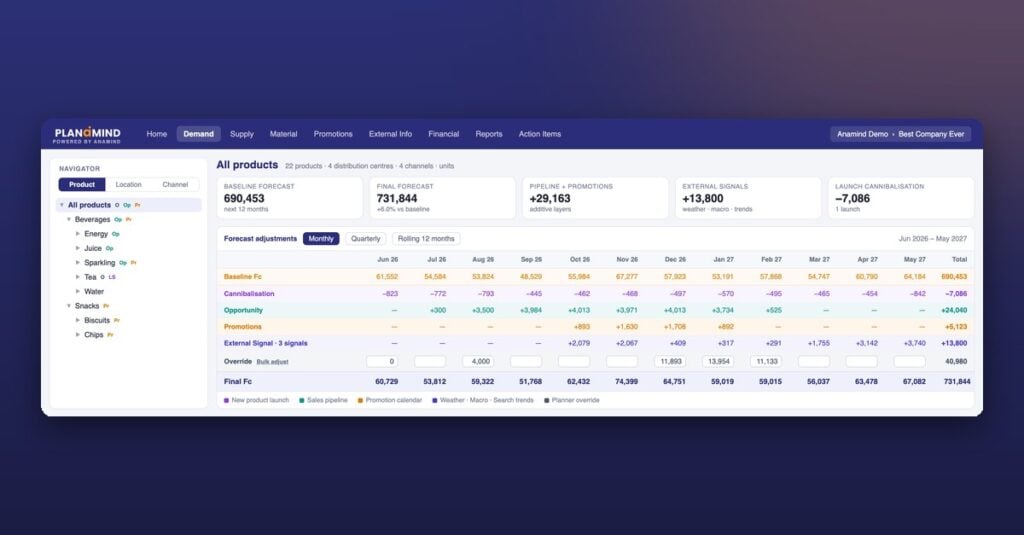
Planamind, Anamind’s AI planning platform, is built around this way of working:
- A strong baseline: 12 forecasting models, with the best fit selected automatically for each item, so collaborators only need to override by exception.
- Collaboration in one place: comment threads, @mentions, tasks, reason codes and a full override history, so everyone sees who changed what and why.
- Forecast value added: an FVA report compares each override against the statistical baseline, with MAPE before and after, and flags collaborators whose changes tend to degrade the forecast.
- Accuracy and bias: FA%, WAPE, MAPE and bias tracked on the forecast accuracy report.
- The financial view: a gross-profit P&L from the plan and a revenue bridge against AOP, so finance and management see the forecast in value.
- Commentary: Ana, the AI planning assistant, writes the Monthly Review commentary, including where to intervene.
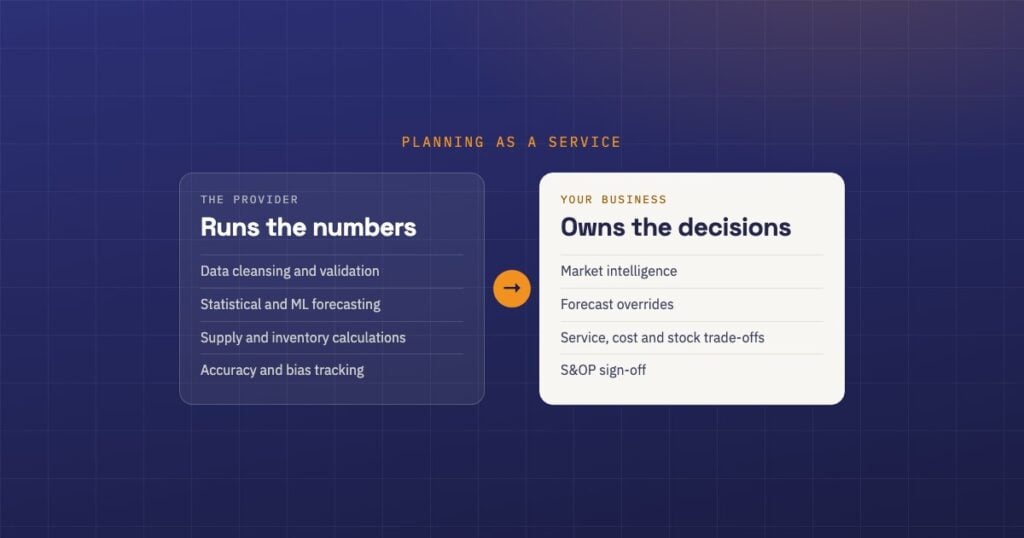
See how it works on the demand planning page. If you need extra planning capacity or expertise, Planning as a Service puts Anamind’s analysts alongside your team.
Frequently asked questions
What is the difference between forecasting and demand planning?
Forecasting predicts what customers will buy. Demand planning takes that prediction and proposes how to change it, for example through promotions, channel programmes or substitutions, and turns it into an agreed plan that supply and finance can act on.
Why should sales give an unconstrained forecast?
Because supply planners need to see real demand. If sales reduce their forecast to match the stock available, the shortfall disappears from view and supply never plans to meet it. Constraints should be applied later in the process by supply chain, operations and finance.
Should sales review every number in the forecast?
No. A good statistical baseline should cover most items. Sales should override by exception, where they have information the model cannot know, such as a new customer, a lost listing or a large order.
What is forecast value added?
Forecast value added measures whether each step in the forecasting process makes the forecast more or less accurate. You compare the error before and after each override, typically against the statistical baseline, and keep the steps that improve it.
Where should demand planning sit in the organisation?
Wherever it sits, it should give an unbiased view of unconstrained demand and have direct access to leadership through S&OP. When it reports into supply chain, planners need to guard against thinking only about cutting supply to match demand rather than finding ways to shape it.