Supply chain planning is now too important, too volatile and too dependent on technology to be run the way most companies run it today: as a fixed in-house team tied to a large, multi-year software implementation. Planning as a Service (PaaS) offers another model. A specialist provider runs the analytical engine of planning on the client’s behalf, with its people, its methods and its technology. The client keeps ownership of decisions and of the business process.
The pressures are familiar. Planning talent is expensive and scarce. Tariffs, geopolitics and demand shocks keep plans in flux. Many firms are also carrying large planning platforms that cost more each year to renew and maintain. And AI is changing what good planning technology looks like faster than any internal team can keep up.
This article sets out what PaaS is, the advantages it offers, and what to get right when adopting it.
What Planning as a Service is
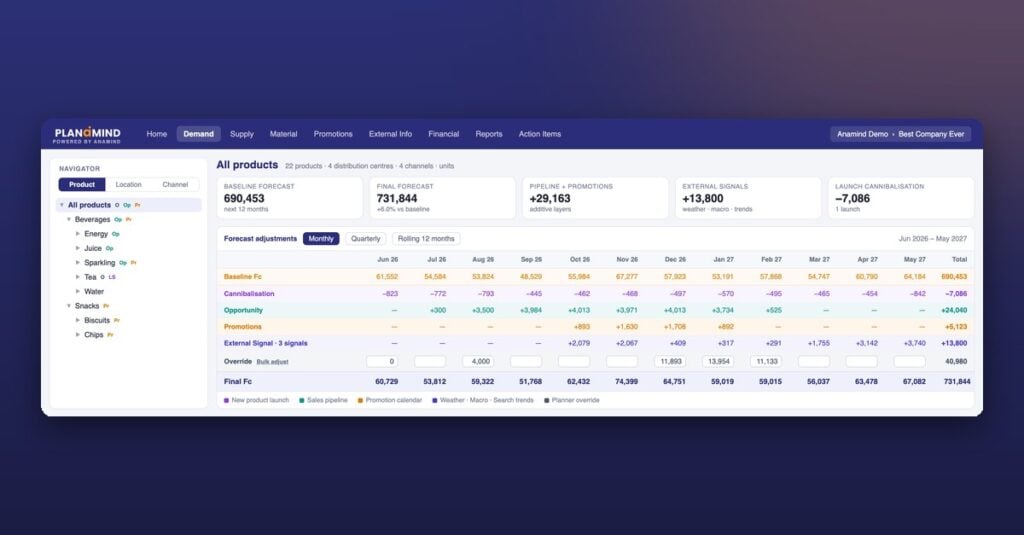
Under PaaS, the client buys a planning outcome, not a software licence or a headcount. The provider delivers an agreed set of outputs: statistical forecasts, supply plans, inventory targets, scenario runs and S&OP-ready analysis. It delivers them on an agreed cadence and to agreed quality levels.
The provider brings three things together under one fee:
- People: trained demand, supply and inventory analysts, often working across time zones.
- Process: proven planning methods, calendars, exception rules and quality checks.
- Technology: the planning platform, data pipelines and analytical models, including AI and machine learning, chosen, run and upgraded by the provider.
The client’s planners and business leaders stay in charge of judgement: market intelligence, overrides, trade-offs and sign-off in the S&OP cycle.
1. Opex instead of capex
PaaS turns planning from a large up-front investment into a predictable operating cost that tracks the value delivered.
A traditional planning transformation is front-loaded. Licences, implementation partners, data integration, testing, change management and internal project teams are all paid for before the first plan comes out. Benefits arrive later, if the project lands. The investment usually needs board-level approval and competes with every other capital request.
Under PaaS, the client pays a recurring service fee. This has several practical effects:
- Cash is preserved. Capital stays available for capacity, acquisitions or debt reduction. This matters more when interest rates make capital expensive.
- Cost follows scope. Fees can be tied to the number of SKUs, regions or planning cycles covered. A company can start with one region or business unit and scale up as results prove out.
- Payback starts sooner. Because the provider’s platform and methods already exist, useful outputs typically arrive in weeks or a few months rather than after a long build.
- Budgeting is simpler. Finance gets one line item with a known run-rate, not a tangle of licence, hosting, partner and internal costs.
- The balance sheet stays lighter. There are no large capitalised software assets to amortise or write down if the strategy changes.
The treatment of a specific contract depends on its terms and the applicable accounting standards, so finance teams should confirm it with their auditors. The economic point holds regardless: the client pays for planning as it consumes it.
2. Attrition risk moves to the provider
When a planner leaves an in-house team, the knowledge often leaves too. Under PaaS, continuity is the provider’s contractual problem, not the client’s operational one.
Planning roles are hard to fill. Experienced demand and supply planners are in short supply, and those who know a particular planning platform well are poached often. The cost of losing one goes well beyond recruitment fees:
- Months of vacancy, during which forecasts go stale or are maintained by overstretched colleagues.
- Months more for a new hire to learn the products, customers, data quirks and system configuration.
- Undocumented know-how lost, such as why a model was tuned a certain way or which data feed cannot be trusted.
- A key-person risk that small teams often cannot cover at all.
A PaaS provider is built to absorb this. It runs a bench of trained analysts, documents methods and client specifics as standard practice, and rotates people across accounts so that more than one person knows each client. When someone leaves, a replacement steps in without the client seeing a gap in output.
The contract makes this enforceable. Service levels on timeliness and accuracy hold whatever happens to the provider’s staff. Recruitment, training, retention and wage inflation in a tight labour market become the provider’s cost and risk.
3. Splitting number crunching from business process
PaaS lets a company split planning into two layers: the analytical engine, which the provider runs, and the business process, which the client owns. Each layer can then be done by the people best suited to it.
In many in-house teams, expensive and experienced planners spend most of their week on data work. They clean history, rerun models, chase missing inputs, reconcile spreadsheets and build reports. Little time is left for what only they can do: talking to sales, understanding customers, weighing trade-offs and driving decisions in the S&OP meeting.
PaaS separates the two.
| Analytical engine (provider) | Business process (client) |
|---|---|
| Data collection, cleansing and validation | Market intelligence and commercial input |
| Statistical and ML forecasting, model tuning | Forecast overrides and their ownership |
| Supply, inventory and capacity calculations | Trade-off decisions on service, cost and working capital |
| Scenario and what-if runs | Choosing which scenarios to act on |
| Forecast accuracy and bias tracking | Accountability for plan outcomes |
| Exception flags and S&OP pre-reads | Running the S&OP and executive review meetings |
This split has several benefits:
- Better use of scarce talent. The client’s planners become business partners rather than data processors. A smaller, more senior team can cover more of the business.
- Clear accountability. The provider is accountable for the quality and timeliness of the numbers. The client is accountable for decisions. Disputes about whose fault a bad plan was become easier to settle.
- Decisions stay inside the business. Commercial judgement, customer relationships and final sign-off never leave the company. Overrides remain the client’s call; the provider simply loads and tracks them.
- A consistent baseline. A specialist running the engine applies the same method every cycle, which makes the statistical baseline a stable reference against which human judgement can be measured.
4. De-risking the fast-moving AI landscape
AI in planning is changing faster than any company can safely commit to a single bet. PaaS hands the job of choosing, testing and switching technology to a provider whose business depends on getting it right.
In only a few years, planning technology has moved from classical statistical models to machine-learning forecasts, demand sensing, probabilistic planning, and now generative and agentic AI that can explain plans, draft S&OP narratives and act on exceptions. New models and tools arrive every few months. Some will last; many will not.
For a company buying its own platform, this creates real risks:
- Betting on the wrong tool. A multi-year commitment to one vendor’s AI roadmap may be overtaken within a year or two.
- Paying for hype. AI modules are often sold as costly add-ons whose value is hard to prove before buying.
- Skills that do not exist in-house. Data science, model monitoring and AI governance are rare skills. They are expensive to hire and hard to keep.
- Model risk. AI models drift, fail silently on unusual data and need constant monitoring.
Under PaaS, the provider carries these risks. It can test new methods across many clients and datasets, keep what works and drop what does not. The client is judged on outcomes such as forecast accuracy, bias, service level and inventory, not on which algorithm was used. When a better method appears, the provider can adopt it without the client running a new selection, contract and implementation.
PaaS also gives a safer path to adoption. AI can be introduced one category or region at a time and measured against the existing baseline, with humans still reviewing the output. The client gains from progress in AI while keeping clear, auditable control over the decisions that follow.
5. Escaping costly renewal and maintenance lock-in
Large planning implementations often become a fixed cost that keeps rising while the business around it changes. PaaS replaces that lock-in with a flexible service that can grow, shrink or change direction.
Many companies installed major planning suites five to fifteen years ago. The original project may have succeeded, but the running costs have grown quietly:
- Rising renewals. Licence and subscription fees tend to rise at each renewal, and vendors’ moves to cloud-only editions often bring higher prices and forced migrations.
- Maintenance and upgrades. Patches, version upgrades, integration fixes and regression testing need a standing internal team or an expensive partner contract.
- Customisation debt. Years of custom code make each upgrade harder and each change slower.
- Underuse. Much of the functionality paid for is never used, or is used only by one or two experts.
- High switching costs. Data, processes and skills are built around one platform, which weakens the client’s position at renewal time.
In uncertain times this rigidity is a real cost. A company facing tariff changes, a divestment, a merger, a supply base shift or a demand downturn needs planning costs that can flex. A long, fixed commitment to a platform sized for yesterday’s business does the opposite.
PaaS changes the terms. The provider owns platform licensing, hosting, upgrades and integration upkeep. The client’s commitment is to a service, usually with defined scope and notice periods, rather than to a technology stack. Companies can use PaaS to retire or shrink a legacy platform at its next renewal, run the service in parallel during transition, and avoid the next large re-implementation altogether.
Why a GCC or a general BPO is not the same answer
Moving planning to a captive global capability centre (GCC) or a general-purpose BPO changes where the work is done and what it costs per head. It does not remove the risks that make in-house planning hard.
Many companies have moved finance, accounting, HR and IT work to GCCs or large outsourcing firms, often with good results. It is tempting to treat planning the same way. On closer look, the comparison breaks down.
The same risks, in a new location
- A GCC is still an in-house team. It carries the same attrition and key-person risk, often more, because GCC hubs are crowded talent markets where skilled planners are hired away quickly.
- The technology burden stays with the company. Platform licences, renewals, upgrades and AI choices remain the client’s problem. The capex, the lock-in and the risk of betting on the wrong AI tool do not move.
- Building takes time and money. A GCC planning team needs hiring, training, process design and senior attention before it delivers, which is the very investment PaaS avoids.
- A general BPO sells capacity, not outcomes. It staffs to headcount and process service levels. It rarely commits to forecast accuracy, bias, service or inventory results, and when its people leave, the planning know-how leaves with them.
Planning is not a transactional process
Accounting and similar functions suit shared services because they are rule-based and standard: the same steps, controls and outputs every month. Planning is different in kind.
- It is judgement-heavy and shifts with markets, portfolios, promotions and supply disruptions.
- It depends on real depth in statistics, machine learning and supply chain trade-offs, not just following process steps.
- Leading planning platforms are now AI-native. Getting value from them means knowing how to configure, tune, monitor and challenge machine-learning and agentic models, and knowing when not to trust them.
- That skill set is scarce and changes fast. It is hard to build and keep where planning is one function among many, as it is in most GCCs and generalist BPOs.
How the three models compare
| In-house or GCC | General BPO | Specialist PaaS | |
|---|---|---|---|
| Attrition and key-person risk | Client | Provider replaces people, but expertise resets | Provider, backed by a planning-trained bench |
| Technology and AI choices | Client | Client | Provider |
| Platform renewals and upkeep | Client | Client | Provider |
| Depth in planning and AI-native tools | Built slowly, hard to keep | Generalist | Core business |
| What the contract measures | Headcount and budget | Process service levels | Planning outcomes |
The real question is not where planning work is done, but who is accountable for doing it well. Of the three models, only a specialist provider makes planning its whole business.
Further advantages
Beyond the five core arguments, PaaS offers benefits that matter most where talent is costly and markets move fast.
Elastic capacity for volatile times
Planning workload is uneven. Product launches, network redesigns, M&A integration, supply crises and annual budgeting all bring peaks. An in-house team sized for the peak sits idle in quiet months; one sized for the average is overwhelmed when it matters most. A PaaS provider can add analysts and computing power for a peak and scale back afterwards, so the client pays for capacity when it needs it.
A response to demographic and labour-cost pressure
Ageing workforces, retiring experienced planners and high wage costs make it harder each year to build deep planning teams. PaaS gives access to a larger, global talent pool through a single contract. The client gets specialist depth without the cost of building every skill locally.
Speed to value
Because the provider’s methods, templates and platform already exist, a PaaS engagement can produce useful plans within weeks. A new platform implementation often takes many months before the first plan runs.
Focus on core business
Manufacturers, distributors and brand owners compete on products, customers and operations, not on running planning software. PaaS lets leadership put management attention and capital where the company competes.
Built-in resilience and security
An established provider brings business continuity plans, backup teams, and certified information-security controls such as ISO 27001. A single in-house team or small IT function often cannot match these on its own.
What to get right
PaaS works when roles, measures and exit terms are clear from the start. Companies weighing the model should settle these points:
- Decision rights. Write down what the provider does and what the client decides. Overrides, final plans and S&OP sign-off should stay with the client.
- Outcome-based service levels. Measure the provider on timeliness, forecast accuracy and bias, data quality, and the business results the plans support, not on hours worked.
- Data ownership and security. The client should own its data, models’ outputs and planning history. Check the provider’s security certifications, data residency, and compliance with regimes such as GDPR.
- Transparency. Insist on explainable methods and access to the underlying numbers, so the client can always see why a plan says what it says.
- Exit and portability. Agree up front how data, documentation and configurations are handed back if the contract ends, so PaaS does not become a new form of lock-in.
- A phased start. Begin with one region, business unit or planning layer, prove the results against a clear baseline, then expand.
- Retained capability. Keep a small internal team that understands planning well enough to challenge the provider and to own the business process.
Conclusion
Planning as a Service gives companies a way to make planning better, cheaper and more resilient at the same time.
It turns a capital-heavy, fixed-cost function into a flexible operating expense. It moves attrition and key-person risk to a provider built to absorb them. It frees scarce planners to focus on judgement and business process while specialists run the numbers. It shields the business from betting on the wrong AI technology. And it offers a way out of the rising renewal and maintenance costs of large legacy implementations.
The question for leadership is no longer whether planning matters, but which parts of it the company must own. For most firms, the answer is the decisions, not the data processing. PaaS lets them keep the first and hand over the second.