Before you spend a dollar on any AI platform, answer these five questions. Be brutally honest. Because your score on these five determines whether AI will transform your supply chain — or just drain your budget.
The AI Supply Chain Gold Rush — And Who Gets Left Behind
There’s a very specific kind of meeting happening in boardrooms across the US right now. The slides say “AI-Powered Supply Chain.” The timeline is aggressive. The vendor has been selected. Everyone’s excited.
And eighteen months later, the system is live, the invoice is paid, and the planner in seat 3B is still spending his mornings untangling spreadsheets. Nothing moved.
This isn’t a rare story. It’s the dominant one. According to Grand View Research, the global AI in supply chain market is growing from $5 billion in 2023 toward over $51 billion by 2030. North America leads with the largest share of that investment. Yet across dozens of implementations, the failure pattern is almost always the same: companies bought AI-readiness they didn’t have. Technology wasn’t a problem. The foundation was.
At Anamind, we’ve spent years sitting inside planning teams — at pharma companies, consumer goods manufacturers, automotive aftermarket leaders, fashion retailers, and Fortune 500 operations — watching what happens when AI meets an unprepared supply chain. We built our AI-powered planning platform and our Planning-as-a-Service model specifically because we saw what was missing long before anyone plugged in an algorithm.
So, here’s what we want you to do before you book another AI demo: answer five questions. Be honest with it.
| 38.9% CAGR of AI in supply chain market through 2030 | 38% North America’s share of global AI supply chain investment 2023 | 32.5% Revenue share held by supply chain planning — largest AI segment |
| Q1 | DATA FOUNDATION |
| Can your data actually feed an AI model? | |
| AI needs clean, granular, consistently structured transactional history: sales orders, shipments, returns, promotions, and inventory movements — all time-stamped, all at the SKU and location level, all free of gaps and duplicates. It also means real-time connectivity, not weekly file dumps. | |
| Anamind’s Demand Planning solution integrates directly with major ERPs (SAP, Oracle, Microsoft Dynamics) creating a single source of truth. But integration alone isn’t enough if the data flowing through it is unclean. That’s why we always begin with a data readiness audit before any platform conversation. | |
| THE HARD TRUTH: Most companies don’t have data. They have spreadsheets, legacy ERP exports, manual corrections nobody documented, and “best guesses” baked into planning templates from 2017. AI can only work with what it’s given. If what it’s given is not trustworthy, you don’t get smarter decisions — you get faster wrong ones. Garbage in, garbage out. Just at machine speed. ⚠ If your planners spend more than 30% of their time cleaning data before they can use it — you are not AI-ready, regardless of what your tech stack looks like. That number is the norm at most mid-market manufacturers we talk to, not the exception. | |
| ✓ FIX IT FIRST Invest in data governance, master data hygiene, and real-time ERP/WMS integration BEFORE buying any AI platform. If you don’t, you’ll spend the first year of your AI contract cleaning data by hand. | |
| Q2 | FORECASTING MATURITY |
| Do you know exactly where your forecast is wrong? | |
| Here’s a question we ask every new prospect: “What’s your forecast accuracy?” Most teams answer, “around 75%.” Then we ask: “Which SKUs are driving the 25% miss?” Silence. That silence costs millions every month. | |
| You need SKU-level tracking of both MAPE (Mean Absolute Percentage Error) and BIAS — because a model that consistently over-forecasts and one that consistently under-forecasts can have identical MAPE scores while creating completely different operational problems. | |
| Anamind’s platform includes built-in AI/ML forecasting with event marking, outlier correction, and regression analysis. The system surfaces your top error drivers automatically, so planners spend their time where it matters. | |
| THE HARD TRUTH: Most planning organizations track forecast performance at the aggregate level — a blended number that feels reassuring but tells you almost nothing actionable. AI doesn’t operate at the aggregate level. It works at the intersection of SKU, location, and time-period. If you can’t measure error at that granularity, you have no baseline to improve against. ⚠ If your team reports a blended accuracy number but can’t tell you which product families, geographies, or time horizons are driving your worst errors — you don’t have a forecasting process. You have a reporting process dressed up as one. | |
| ✓ FIX IT FIRST Establish SKU × location × week forecast error tracking using MAPE + BIAS. Identify your top 20 error drivers before deploying any ML model. This exercise will tell you more about your planning health than any dashboard you’ve ever seen. | |
| Q3 | HUMAN + AI ALIGNMENT |
| Will your planning team actually trust what the AI tells them? | |
| This isn’t a criticism of experienced planners. Their intuition carries real value — they know the promotions that skew history, the seasonal dynamics the model hasn’t seen enough cycles to learn. The goal isn’t to replace that expertise. It’s to make it auditable and data driven. | |
| The solution is an ‘informed override’ culture. Planners should absolutely override AI recommendations — but they should log the reason every time they do. That log creates accountability for leadership and becomes training data that makes the model smarter over time. | |
| Anamind’s S&OP Collaboration platform makes the AI’s reasoning transparent. Planners can see why the system is recommending what it’s recommended — a fundamentally different experience from a black-box output that arrives without context. | |
| THE HARD TRUTH: The biggest reason AI supply chain implementations fail isn’t the algorithm. It’s the planner with fifteen years of experience who overrides every recommendation the system makes — not because the AI is wrong, but because they were never given a reason to trust it. Without deliberate change management, AI becomes an expensive decoration. ⚠ If your planners are overriding AI recommendations more than 40% of the time and can’t document why — your AI investment is producing zero business value, regardless of how sophisticated the model is. | |
| ✓ FIX IT FIRST Build an ‘informed override’ culture before you deploy AI. Require planners to log override reasons. Run a change management program that involves planners in model validation — not as passengers but as co-authors of the AI’s learning process. | |
| Q4 | PROCESS READINESS |
| Is your S&OP process fast enough to absorb AI insights? | |
| If your consensus meeting happens monthly and cascading the output into procurement schedules takes another three weeks, you’ve built a 30-day lag into a system that generates fresh intelligence every day. The AI is sprinting. Your process is walking. | |
| Companies that fail to compress their planning cycles to match the speed of AI-generated insight will systematically underperform those that do. In 2025, tariff volatility from the US trade environment forced companies into replanning scenarios their monthly S&OP processes simply couldn’t accommodate in time. | |
| Anamind’s S&OP Collaboration tools surface exceptions, prioritize decisions by business impact, and create a shared workspace where cross-functional teams can align quickly — not after a three-week cascade. | |
| THE HARD TRUTH: AI can generate a fresh demand signal in minutes. Modern AI forecasting tools are continuously recalibrating based on POS data, weather, economic indicators, order patterns, and promotional calendars. The insight is almost always ready before anyone has acted on the last one. The bottleneck is the process around the AI. ⚠ A monthly S&OP cycle is a structural 30-day lag. In the volatile supply chain environment of 2026 — with tariff shocks, geopolitical disruption, and demand signals shifting week-to-week — that lag translates directly into lost sales, excess inventory, or both. Every single month. | |
| ✓ FIX IT FIRST Redesign your S&OP cycle around weekly exception-based reviews before deploying AI. AI only creates value when your process can absorb and act on its outputs at the speed they are generated. Otherwise, you are paying for intelligence you are not using. | |
| Q5 | ROI CLARITY |
| Have you defined what “good” actually looks like after AI? | |
| This isn’t just about accountability after the fact. It’s about making better investment decisions upfront. When you know your current MAPE is 28% at the SKU level, you can set a meaningful target of 20% and understand what that improvement is worth in dollar terms. | |
| When you know your current inventory days-on-hand is 72, you can model what getting to 58 would do to working capital. These numbers change how you prioritize, what you implement first, and how you evaluate vendors. | |
| Our ROI Calculator is available at anamind.com/resources/roi-calculator/ — it’s the first conversation we want to have, not the last. Use it before you evaluate any platform. | |
| THE HARD TRUTH: Companies rush into implementation because the technology is compelling and competitive pressure is real. Twelve months later, the system is live. The vendor celebrates. Then someone in the CFO’s office asks: “What did this actually do for us?” Nobody has a clean answer — because nobody established a baseline before they started. No baseline = no ROI story. ⚠ If your AI proposal doesn’t include a specific forecast accuracy improvement target, a concrete inventory reduction goal, and a service level benchmark — it is a science project, not a business case. Enthusiasm is not a KPI. | |
| ✓ FIX IT FIRST Baseline your current metrics today: MAPE, BIAS, inventory days-on-hand, service fill rate, planning cycle time, override rate. These numbers are your before photo. Anamind benchmarks target 10–20% inventory reduction + 5–20% forecast accuracy improvement within 12 months. | |
Your AI Readiness Score
Score yourself honestly on each of the five questions. One point if your organization has genuinely addressed the readiness requirement — zero if you haven’t, or if you’re not sure. Total your score and find your profile below.
| Score | Profile | What It Means | Next Step |
| 0–1 | Not Ready | Foundational gaps in data and process. Any AI investment will fail without fixing this first. | anamind.com/contact/ |
| 2–3 | Partially Ready | Some pieces in place but critical gaps remain. Fix-it program before platform selection. | anamind.com/planning-as-a-service/ |
| 4 | Almost There | Strong foundation — the main risk is adoption and culture. Focus on change management now. | anamind.com/solutions/ |
| 5 | AI-Ready 🚀 | Genuinely positioned to extract value from AI. Every month of delay is competitive disadvantage. | anamind.com/contact/ |
“AI doesn’t fail because the algorithm is wrong. It fails because the organization wasn’t ready to use it right.”
How Anamind Actually Gets You There
We’re not a software company that hands you a platform and wishes you luck. Anamind was built — by practitioners, for practitioners — around one conviction: the gap between data and decision-making is a capability gap, not just a technology gap. Closing it requires the right tools, the right process design, and the right people alongside yours.
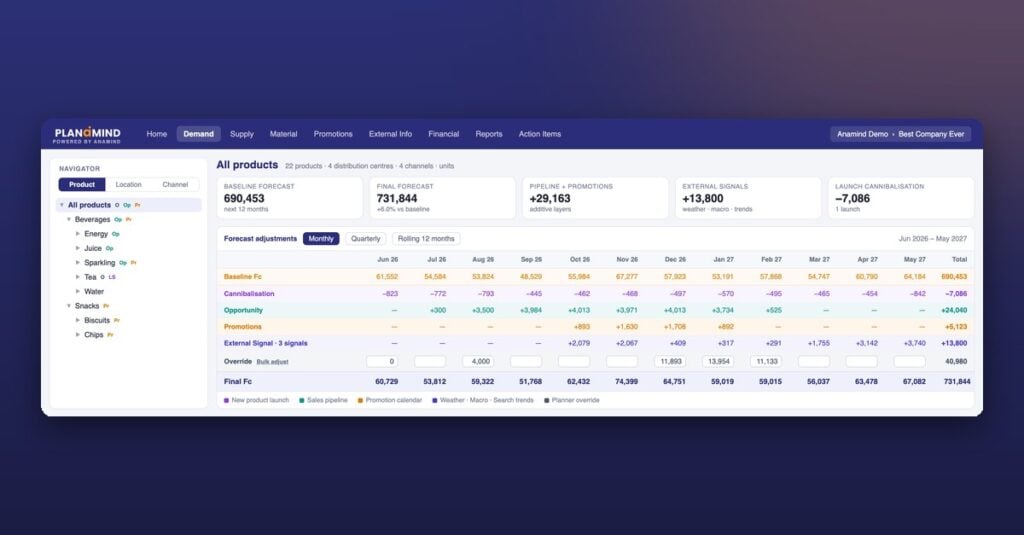
| Demand Planning & AI Forecasting AI/ML automatic forecasting with event marking, outlier correction, regression, and what-if analysis at SKU × location × week granularity with ERP integration built in. → Explore Demand Planning | Stock Replenishment Planning Discrete event simulation of your supply chain. Dynamic inventory optimization. Expiration management. Safety stocks calibrated to actual demand variability. → Explore Replenishment Planning |
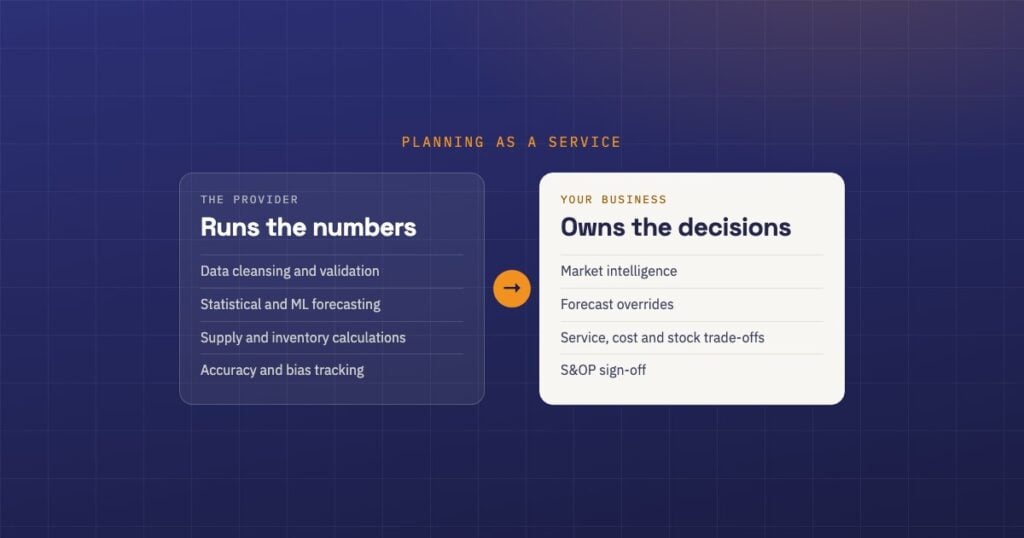
| S&OP Collaboration & Reporting Compress your planning cycle without losing alignment. Exception-based review of workflows, shared planning boards, and real-time visibility that replaces the monthly marathon with weekly precision. → Explore S&OP Tools | Planning-as-a-Service (PaaS) Not ready to build an internal AI planning capability from scratch? Our PaaS model gives you Anamind’s expert team as your extended planning arm — without IT capex or the risk of team attrition unraveling your investment. → Explore PaaS |
| MRP & Procurement Planning BOM mapping, multi-supplier management, container capacity optimization — so purchasing decisions flow from the same demand signal driving your forecast. → Explore MRP Planning | ROI Calculator & Assessment Before any platform conversation, we baseline your current metrics. Our free ROI Calculator shows the dollar impact of closing your specific readiness gaps — grounded in benchmarks from real implementations. → Use the ROI Calculator |
Industries We Serve
Anamind works with companies across pharma and healthcare, consumer goods, fashion and retail, food and beverage, automotive aftermarket, chemicals and paints, home interiors, and industrial products. From startups building their first planning capability to Fortune 500 operations redesigning theirs, the engagement model is always the same: we start with your problem, not our product.
Our case studies include a North American pharmaceutical manufacturer that cut inventory by nearly 50% within months of implementation — starting from a place of “perfect storm” chaos involving DSCSA compliance, tariff exposure, and cold-chain complexity. That result wasn’t magical. It was a structured readiness program followed by the right tools deployed in the right sequence.
Browse our planning templates and research papers to start building your foundation before we talk. Or join one of our webinars — we run them regularly with industry leaders across sectors.
The 2026 Reality Check
Supply chain leaders going into 2026 are navigating a genuinely difficult environment: tariff uncertainty forcing constant network replanning, AI tools moving from pilot programs into daily operational use, and a widening gap between organizations that have built planning capability and those still reacting to disruptions after the fact.
The companies winning right now aren’t the ones who bought the most sophisticated AI. They’re the ones who built the strongest planning foundation first — and then used AI to multiply the capability they’d already built. That’s what we help companies do. Not just selling software but building the capability that makes the software worth buying.
If your score on the five questions above left, you uncomfortable — good. That discomfort is information. Use it.
Not Sure Where You Stand?
Book a free 30-minute readiness assessment with the Anamind team. Just an honest look at where your supply chain is today — and what it will take to get it AI-ready.
→ Book Free Assessment | anamind.com/contact/
→ Try the ROI Calculator | anamind.com/resources/roi-calculator/
About Anamind
Anamind is an Advanced Analytical Planning company helping businesses build AI-powered supply chain capabilities across demand planning, inventory optimization, MRP, procurement, and S&OP. We work with manufacturers, retailers, and distributors across pharma, FMCG, automotive, fashion, and industrial sectors globally. Learn more →